Material Testing 10 November 2026 6 min read
Concrete Cube Compressive Strength Test: What Your Results Really Mean
The cube test is the most common quality check on any building site. Here is how it works, when to test, and how to read a report without guesswork.
Every slab, beam and column on your project depends on one number: the compressive strength of the concrete. The cube test is how that number is confirmed, and it is the single most requested test at our Gujranwala lab.
How the test works
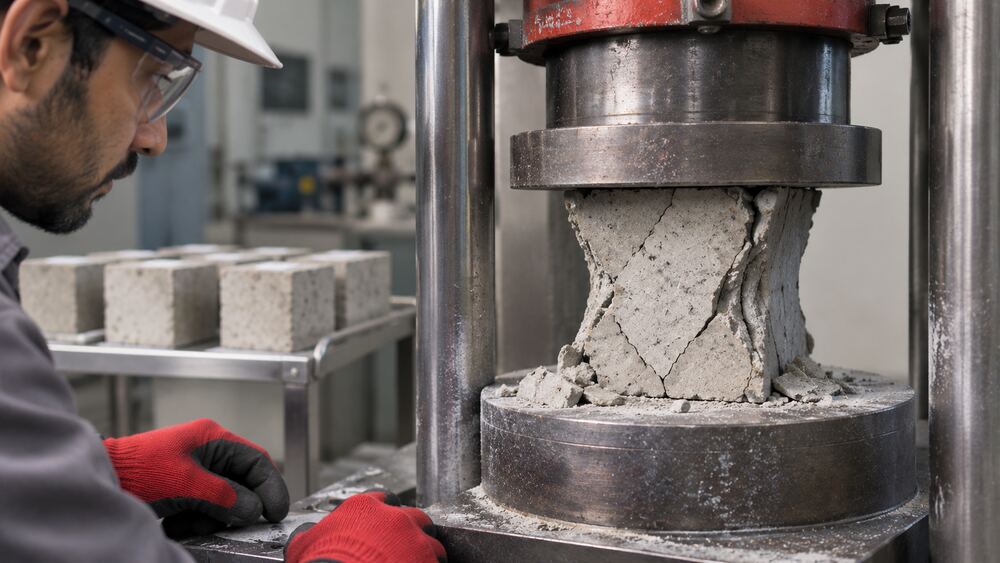
Fresh concrete is sampled at the point of pour and cast into standard steel moulds, usually 150 mm cubes. The cubes are cured in water and then crushed in a calibrated compression testing machine at fixed ages, typically 7 and 28 days. The maximum load at failure, divided by the loaded area, gives the compressive strength in N/mm² (MPa).
Why two ages?
- 7 days gives an early warning. Ordinary concrete usually reaches roughly two thirds of its 28 day strength by this point.
- 28 days is the reference age that designers specify, for example C25 or C30.
Reading the report
A good report lists the cube ID, casting date, testing date, weight, density, failure load and strength for each specimen, plus the average of the set. Look for three things:
- The average strength of the set compared with the specified grade.
- The spread between cubes. Large variation points to poor sampling, compaction or curing.
- The failure pattern. A normal failure leaves two pyramids. Unusual cracks often mean the cube was not cast or capped correctly.
A low result does not always mean bad concrete. It can also mean bad cubes. That is why sampling and curing discipline matter as much as the mix.
When results come back low
Do not panic and do not demolish. The usual next step is to assess the concrete in place using non-destructive methods such as the rebound hammer and ultrasonic pulse velocity, followed if needed by core samples taken from the structure. Our team can coordinate the full sequence so you get a clear engineering answer.
Practical tips for site teams
- Sample from the middle of the discharge, not the first or last bucket.
- Compact cubes in layers and label them immediately.
- Keep cubes shaded and damp for the first 24 hours, then move them to water curing.
- Send cubes to the lab with a simple record of pour location and grade.
Need cubes tested this week? Send them to our lab on Khalid Bin Waleed Road or ask us to collect them from site.