Inspection 27 October 2026 7 min read
NDT Explained: Ultrasonic, Magnetic Particle and Dye Penetrant Testing
Three non-destructive methods that find cracks and hidden defects without cutting a single sample. Which one fits your weld, casting or structure?
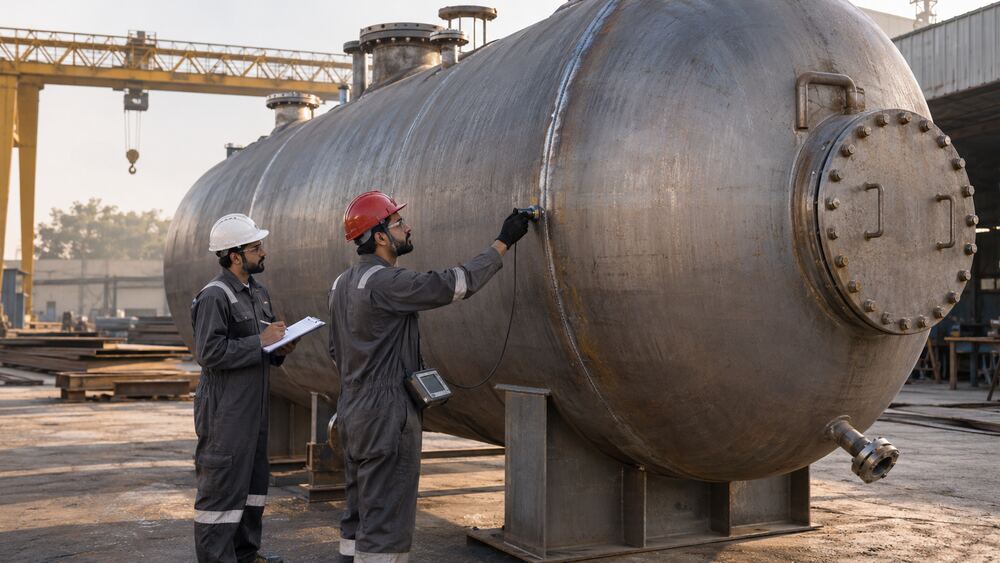
Non-Destructive Testing, or NDT, lets inspectors examine welds, castings and structural members without damaging them. The part stays in service, and you get evidence of its condition. These are the three methods our clients ask about most.
Ultrasonic Testing (UT)
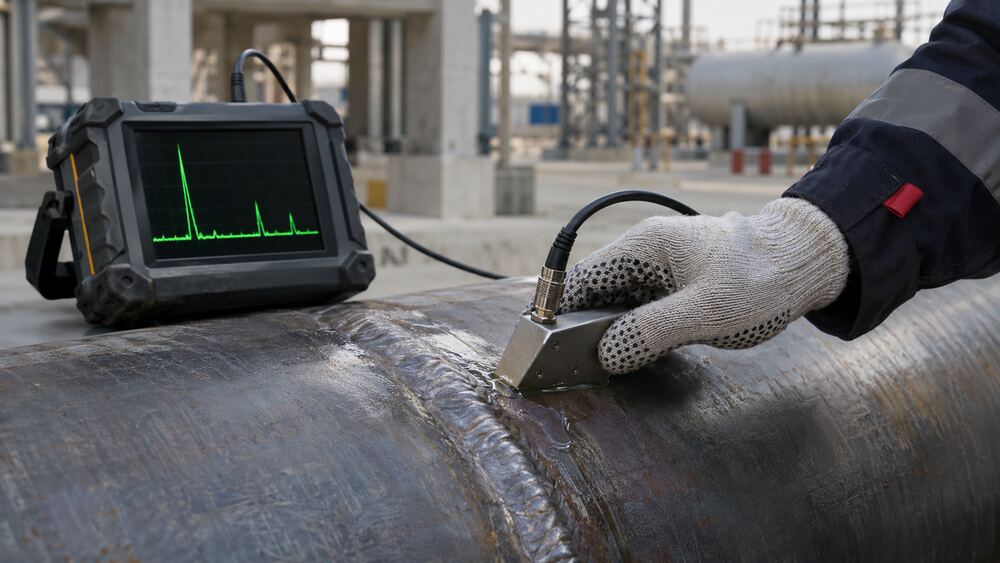
A probe sends high frequency sound waves into the metal. Sound reflects back from the far wall and from any internal flaw such as lack of fusion, slag or cracks. The echo pattern on the flaw detector tells the inspector the size and depth of the defect.
- Best for: butt welds, thick plates, forgings, thickness gauging of tanks and pipes.
- Strength: finds internal defects and measures remaining wall thickness.
Magnetic Particle Testing (MPT)
The part is magnetised, usually with a portable yoke, and fine iron particles are applied. A surface or near surface crack disturbs the magnetic field and the particles gather along it. Fluorescent particles under UV light make even hairline cracks easy to see.
- Best for: fillet welds, lifting lugs, crane hooks, shafts and structural steel connections.
- Limit: works only on ferromagnetic materials such as carbon steel.
Dye Penetrant Testing (DPT)
A coloured liquid penetrant is applied to a clean surface and drawn into any open crack. After the excess is removed, a white developer pulls the dye back out, showing a sharp red line wherever a defect breaks the surface.
- Best for: stainless steel, aluminium and non-magnetic parts, small components, machined surfaces.
- Limit: detects only defects that are open to the surface.
Choosing the right method
| Question | Usual choice |
|---|---|
| Is there a crack on the surface of a steel weld? | MPT |
| Is there a crack on stainless or aluminium? | Dye penetrant |
| Is the weld sound all the way through? | Ultrasonic |
| How much wall thickness is left? | Ultrasonic thickness gauging |
In practice, many inspections combine methods. Tell us what the part is and how it is loaded, and our inspectors will propose the right scope.